

Bad Boys of IMSA Part 2: Randy Lanier
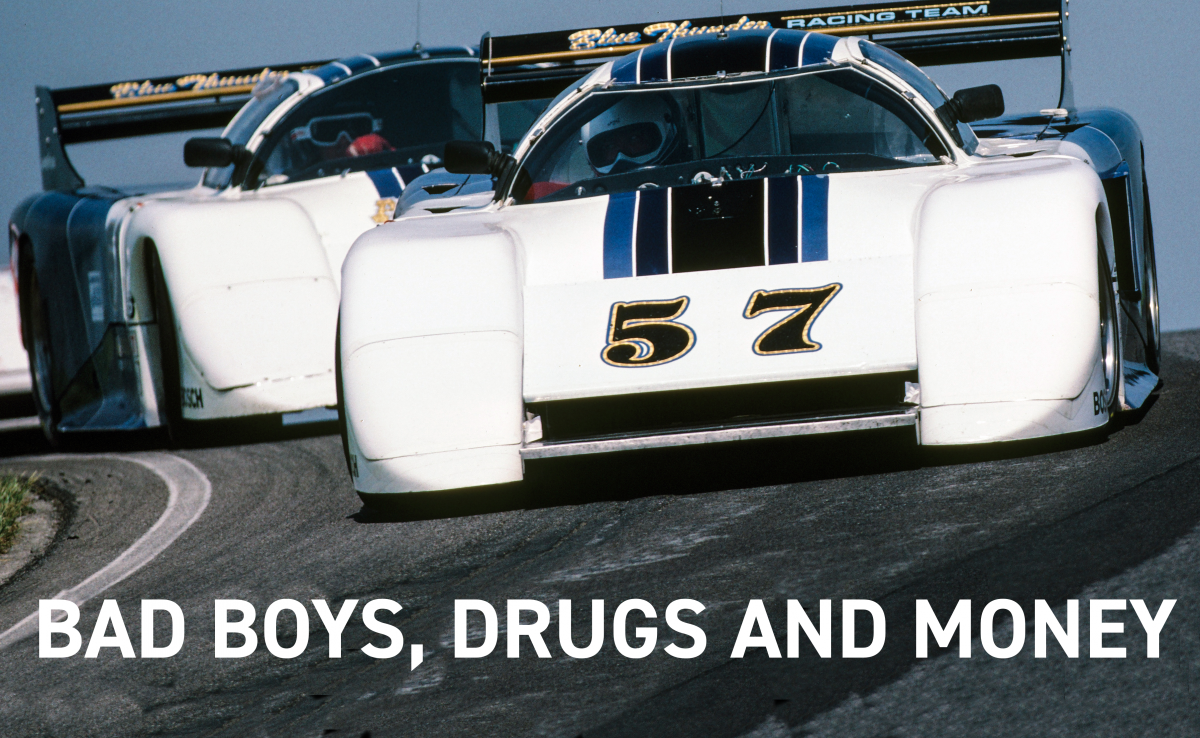
In this excerpt from our award-winning book, IMSA 1969-1989, we meet colorful driver Randy Lanier, and learn about a bad boy that paid for his sins. For the full story read IMSA: 1969-1989.
Chapter Introduction
It’s no secret racing takes talent and money – lots of it, especially if you want to compete for the top step of the podium. Most of the team owners at the sharp end of the grid in the Camel GT Series made their money by legitimate means and many developed beneficial sponsor deals to support them. But no history of the Camel GT Series would be complete without telling the stories of the bad boys of IMSA, the few that made their racing money on the wrong side of the law.
The stories about these outlaws were outrageous and at times hard to believe. The tales about their rise to fame and inevitable falls from grace have taken on a life of their own over the years, both tainting the Camel GT Series and giving it the kind of spice that makes for the stuff of legends. “The running joke in the paddock at the time was that IMSA stood for the International Marijuana Smugglers Association,” recalled Bobby Rahal. The truth was far more mundane; the bulk of Camel GT fields were made up of honest businessmen, but the bad apples stood out and attracted all the wrong kind of salacious media coverage.
Racing on the Edge: Randy Lanier
Randy Lanier's family moved to Melbourne, Florida when he was a teenager, during a time when television’s Don Johnson and Miami Vice glamorized the South Florida drug scene. The lure of a fast-paced lifestyle impacted young Lanier. More interested in going to the beach with friends or smoking pot than attending classes, he began selling marijuana to high school classmates as a way of earning some quick money and getting to smoke weed for free.
About to be suspended for selling a joint to a classmate, Lanier dropped out of high school and started working construction jobs. But he was soon selling pot to fellow construction workers. The money was good, way better than what he was earning with hard labor. The business escalated and at the age of nineteen, he bought his first speedboat. From there, it was a relatively small jump to ferrying marijuana for the local mob from offshore ships to drop areas on the beach. Over time, the boats became bigger, faster, and more elusive. Before he reached the age of thirty, Lanier found himself in charge of a multi-million dollar trafficking business that was bringing in more than 100,000 pounds of drugs a year directly from Columbia to various ports on the East Coast.
Lanier’s racing career was the definition of meteoric. It started almost by accident when he signed up for lessons at an SCCA booth at a local trade show in the late 1970s. After fixing up a 1957 Porsche 356 in his carport, he raced at SCCA events with enough success to earn himself a spot at the 1980 National Runoffs at Road Atlanta, where he met John Paul Sr. Having started to race relatively late in life, he was making up for lost time.
Lanier’s first contact with IMSA racing happened at the 1981 season finale at Daytona, where he co-drove with Dale Whittington in a 935. Lanier made the rounds of the paddock at Daytona and instantly bonded with the other South Florida guys who were by then a regular part of the IMSA scene: Whittington brothers, Preston Henn, and Marty Hinze.
At the 1982 24 Hours of Daytona, he was pressed into service as a last-minute stand-in for an ailing Janet Guthrie at the wheel of an N.A.R.T. Ferrari 512 BB/LM with Bob Wollek as the lead driver. Lanier crashed the car out of third place during his first stint in the car, eighteen hours into the race.
By March, he was co-driving a 935 with Dale Whittington and Henn in the Sebring 12 Hours. He shared a similar ride with Hinze at Charlotte in May. At the annual Daytona Paul Revere race in July, he finished fourth overall with Henn, followed by a third-place podium with Hinze at Mosport in August. Lanier was building a reputation as a fast driver with means. From out of nowhere, he scored enough points in 1982 to finish sixteenth in the season standings and was invited by Preston Henn to co-drive a Ferrari 512 BB/LM at Le Mans that year. Lanier would finish an impressive second in the 1983 24 Hours of Daytona.
Along with Bill Whittington, Lanier formed Blue Thunder Racing in early 1984. The name of the team was purposeful and pointed to Lanier’s growing recklessness around his business dealings. Blue Thunder referred to a thirty-nine- foot, twin-hulled catamaran designed by Don Aronow, a world champion speedboat pilot and famous designer/builder of high-speed, cigarette-style boats. He sold fourteen Blue Thunder boats to the US Customs Service on the promise they could out-run the single-hull boats smugglers were using, many of which were also designed by Aronow. Turned out, the Blue Thunder boats couldn’t and the government wasted millions on the program.
Years later, Aronow was gunned down in broad daylight on February 3, 1987, in Miami. Almost ten years after the murder, a career criminal named Bobby Young and speed- boat ace Ben Kramer, owner of Apache Powerboats and Lanier’s sponsor during his 1984 Camel GT title run, each pleaded no contest to the killing. Apparently, the shooting was in retaliation for a business deal gone sour, but rumors have since swirled that the real story went deeper. At the time, Kramer was already serving a lengthy prison sentence with a group of inmates that included Lanier.
Helped with setup and coaching by Bill Whittington, and armed with a March 84G-Chevy, Lanier won six races in 1984 and finished in the top five another five times to clinch the Camel GT championship in just his second year of full- time IMSA racing.
Ironically, his quick success sowed the seeds of Lanier’s ultimate downfall. Without visible means of support, little sponsorship, and without the involvement of March Engi- neering, Lanier had somehow pulled off a miracle champi- onship against seemingly better-funded and more skilled competition. Federal authorities, having already been on the trail of the Whittingtons, began investigating.
In 1985, Lanier turned his attention to CART’s Indy cars and entered the Indianapolis 500. He wasn’t allowed to compete by race organizers due to his lack of oval experience, but he returned the next year to obliterate the rookie qualifying record. He started thirteenth, finished tenth, and earned Rookie of the Year honors. But by this time, the Whittingtons were busy dealing with their legal issues and the noose was tightening on Lanier.
Along with ten other people, Lanier was indicted on money laundering and drug trafficking charges in Miami federal court in October 1986, for bringing marijuana into Florida. The organization was estimated to be importing in excess of 300 tons of marijuana every year from Columbia in a sophisticated operation that involved speedboats, barges, tugboats, and trucks. Money from the operation was being laundered through a network of fictitious organizations and international banks. Lanier’s business partners were also indicted: Ben Kramer (who would later confess to the murder of Aronow) and Kramer’s father, Jack. Although recovering from a broken leg sustained in a crash during CART’s five- hundred-mile race in Michigan, Lanier surrendered to authorities and was released on bail.
Lanier’s legal issues worsened in January 1987 when additional federal charges were leveled in Illinois that accused him of being a “drug kingpin” who had smuggled more than 150 tons of marijuana into the country over the previous three years. The operation in Illinois had come unraveled when a state trooper came across a disabled truck on the side of the road that contained a small amount of marijuana. The trail led directly back to Lanier and his partners. Now facing the possibility of significant jail time, he fled the country, only to be recaptured while fishing in Antigua a few months later.
Following a three-month trial in 1988, Lanier was convicted of engaging in a continuing criminal enterprise, conspiracy to distribute more than 1,000 pounds of marijuana, and tax fraud. For these crimes, he was sentenced to life in prison without the possibility of parole. The harsh sentence was the result of a 1984 law called the “Super Drug Kingpin” provision of the Continuing Criminal Enterprise Statute, designed to deter others from going into the drug distribution business. After spending twenty-six years in federal prison and without explanation from the government, Lanier was released in October 2014.
The reaction from IMSA to the spate of drug trafficking convictions was predictably subdued. “We felt kind of sick inside,” remembered John Bishop. “We were worried, of course, about the reaction from R. J. Reynolds, but they were pretty mature about it. They’d been through the same kind of thing with some NASCAR teams, so they weren’t exactly innocent about the potential of the problem, but we weathered that together and it wasn’t as traumatic as it could have been.”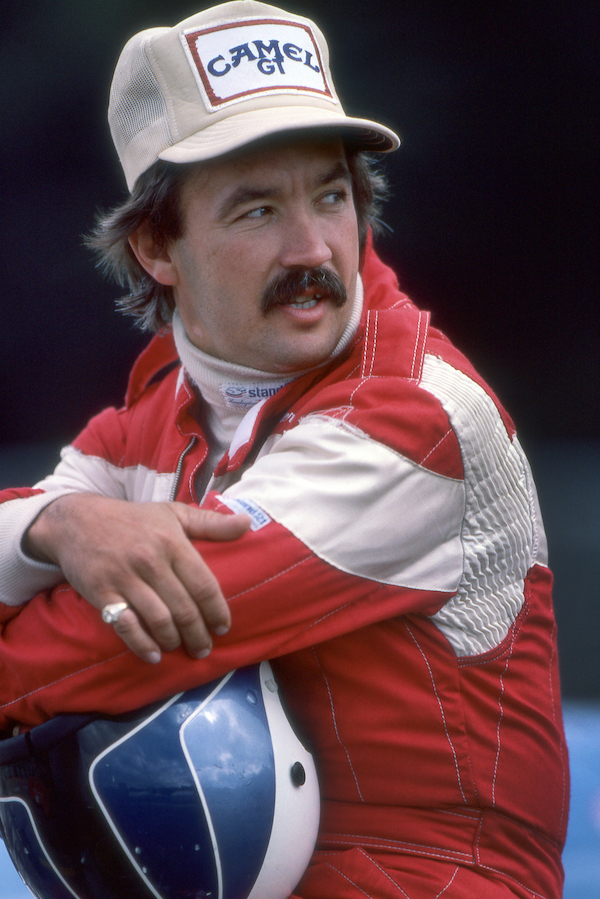
Randy Lanier during his 1984 championship winning season.
Bob Harmeyer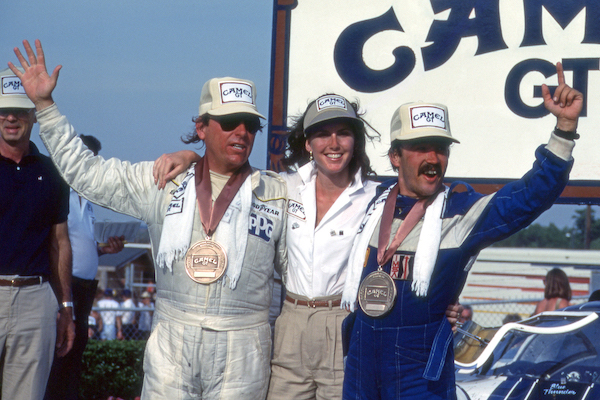
Randy Lanier, on right, on the podium with Bill Whittington. Rob Hermann
Want to read more about the Bad Boys of IMSA? Check out Part 1: John Paul, Sr. ; and Part 3: The Whittington Brothers.