


Bad Boys of IMSA Part 1: John Paul Sr. and His Legendary Temper
The following is an anecdote about IMSA driver John Paul, Sr. For the full story on his legendary temper, read IMSA: 1969-1989.
It’s no secret racing takes talent and money – lots of it, especially if you want to compete for the top step of the podium. Most of the team owners at the sharp end of the grid in the Camel GT Series made their money by legitimate means and many developed beneficial sponsor deals to support them. But no history of the Camel GT Series would be complete without telling the stories of the bad boys of IMSA, the few that made their racing money on the wrong side of the law.
The stories about these outlaws were outrageous and at times hard to believe. The tales about their rise to fame and inevitable falls from grace have taken on a life of their own over the years, both tainting the Camel GT Series and giving it the kind of spice that makes for the stuff of legends. “The running joke in the paddock at the time was that IMSA stood for the International Marijuana Smugglers Association,” recalled Bobby Rahal. The truth was far more mundane; the bulk of Camel GT fields were made up of honest businessmen, but the bad apples stood out and attracted all the wrong kind of salacious media coverage.
The first of these characters was Hans Johan Paul who emigrated from the Netherlands to the U.S. with his parents in 1956. He changed his name to John Paul, married and had a son in 1960 that he also named John. After graduating from Harvard, he became a successful mutual fund manager and began to amass considerable wealth.
John Paul Sr. began his racing career with local SCCA events in the 1960s, winning an SCCA Northeast Regional Championship in 1968. Domestic strife derailed his racing career and estranged him from his son for a few years, but he resumed racing in the early 1970s, entering a Corvette in IMSA races.
The elder Paul shared a Porsche Carrera with John O’Steen and Bob Hagestad at the 24 Hours of Daytona in 1977. He would go on to contest the bulk of that season, sometimes in a Carrera but mostly in a Monza. For the 1978 season, Paul Sr. competed in the latest specification AAGT big-block John Greenwood Corvette, ultimately finishing a credible sixth in the points standings. The next year he upgraded to a Porsche 935 and not only competed in the Camel GT Series, finishing 12th in the points standings, but also won the 1979 SCCA Trans-Am Category II championship in the same car.
It’s not clear how John Paul Sr. got tangled up in the drug trade, but his legal issues began in January 1979 when he was caught with $10,000 cash and more than 1,500 pounds of marijuana in the bayous of Louisiana. Remarkably, he got away with just a fine and three years of probation after pleading guilty to marijuana possession. Not many in the IMSA paddock knew about his brush with the law, but whispers began circulating about the source of the money that supported his increasingly large racing budget. His light blue cars always seemed to be unsponsored, at least until 1982 when Miller beer jumped on in the form of an Atlanta area beer distributor providing support.
The 1980 season turned out to be his best. By this time, John Paul Jr. had begun racing in lower formulas and demonstrated a keen natural talent. Together, father and son won the 1980 Lime Rock Camel GT race. Remarkably, it was the younger Paul’s first-ever IMSA race and the first time he raced the 935. They added a win at Road America and Paul Sr. went on to score another ten Top 5 finishes and ended up second in the Camel GT championship. He also won the 1980 FIA World Challenge for Endurance Drivers, which compiled points from selected long-distance races, five on the IMSA schedule and five FIA events at Monza, Silverstone, Nurburgring, Le Mans and Spa.
Taking advantage of more liberal rules intended to keep the 935 competitive with GTP prototypes, Paul Sr. had a full ground-effects 935 developed for the 1982 season, dubbed the JLP-4 to distinguish it from the older but very successful JLP-3, on which he had also spent an enormous sum. Although the car only faintly resembled the original 935, it was a rocket ship and helped propel John Paul Jr. to the 1982 Camel GT championship. The elder Paul won the Camel Endurance Championship the same year. It was to be the last hurrah for the JLP team.
Out of sight, federal authorities had spent a year carefully building a case against Paul Sr., ultimately indicting him for marijuana smuggling. On April 19, 1983, Stephen Carson, the key federal witness in the case, was shot and nearly killed by Paul Sr. at a marina in Florida. Apparently, Paul Sr. arranged for the late-night meeting and for unknown reasons, Carson agreed to show up. Without his testimony, the federal authorities didn’t have much of a case. The plan backfired when Carson survived the attack. He and a companion both identified Paul Sr. as the shooter and he was quickly arrested. Charged with attempted murder of a federal witness, his legal problems had been significantly compounded.
Then, things got worse; Paul Sr. skipped bail before his scheduled trial in December of 1983. Thirteen months after jumping bail, he was caught living under an assumed name in Switzerland and extradited back to the U.S. On top of pleading guilty in 1986 to attempted murder, he was tried and convicted of tax evasion and drug smuggling charges in 1987. After serving 11 years in prison including one attempted escape, Paul Sr. was paroled in 1999. He was questioned but not detained in the mysterious 2000 disappearance of Colleen Wood, a woman who had joined him for an extended sailing cruise. She has never been found. Paul subsequently disappeared to whereabouts unknown.
John Paul Jr. was an extraordinary talent behind the wheel of a race car and was recognized by team owners such as NASCAR’s Junior Johnson as one of America’s top young drivers. His IMSA success gave him choices. He moved to CART racing in 1983 and in only his fourth start passed Rick Mears on the last lap to win the Michigan 500, justifying predictions of future success. Continuing in IMSA on board the potent Phil Conte-owned RC Cola Buick March, Paul Jr. eventually got caught out by his father’s illegal activities and was indicted while the manhunt for his father was ongoing.
After pleading guilty to federal racketeering charges in 1985, he spent more than two years in prison. Upon his release in 1988, the racing community opened its arms to him. He had done his time, and many felt his father had bullied him into the drug trafficking trade against his will. Paul Jr. resumed his racing career, scoring seven IMSA wins and an Indy Racing League victory at Texas in 1998 – 15 years after that inaugural Indy car win in Michigan. He competed in seven Indy 500s with a best finish of seventh in 1998.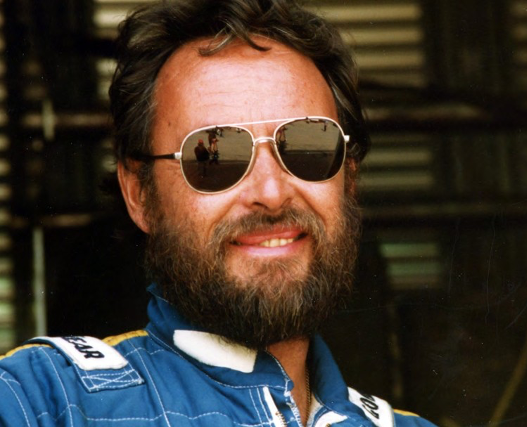
John Paul Sr. relaxes before a Camel GT race. Rob Hermann
As John Paul Sr. became a familiar sight in the IMSA paddock, so did his legendary temper. Check out stories One story as related by Jim Busby: “I had decided to do the 1977 Mid-Ohio race on my own. Most other guys had co-drivers, but I had driven the race alone before and won it. But this time, about three hours into the race, my hands started cramping and I was so hot that I started to hallucinate. I radioed into my crew chief: ‘We need to find a co-driver, fast!’
“As it happened, we were pitted right next to John Paul Sr. My crew chief looked down and John O’Steen, Paul Sr.’s designated co-driver, was suited up, ready to take over. Without telling me anything on the radio, he runs down and convinces him to get in my car instead, explaining all the knobs, buttons, and shift patterns of a 935 to him while they wait for me. “I pit and O’Steen gets in and takes off. After about forty-five minutes of rest in the pits, I cool off enough to resume driving and take it to the end of the race. When I get back to the pits, John Paul Sr. is waiting for me—livid. He’s screaming that he’s going to kill me and shoot my crew. I had no idea what was going on. It was real scary. Yes, we were in the wrong and ruined his race, but I didn’t think it was a crime punishable by death. Like a lot of people, I steered clear of him after that.”